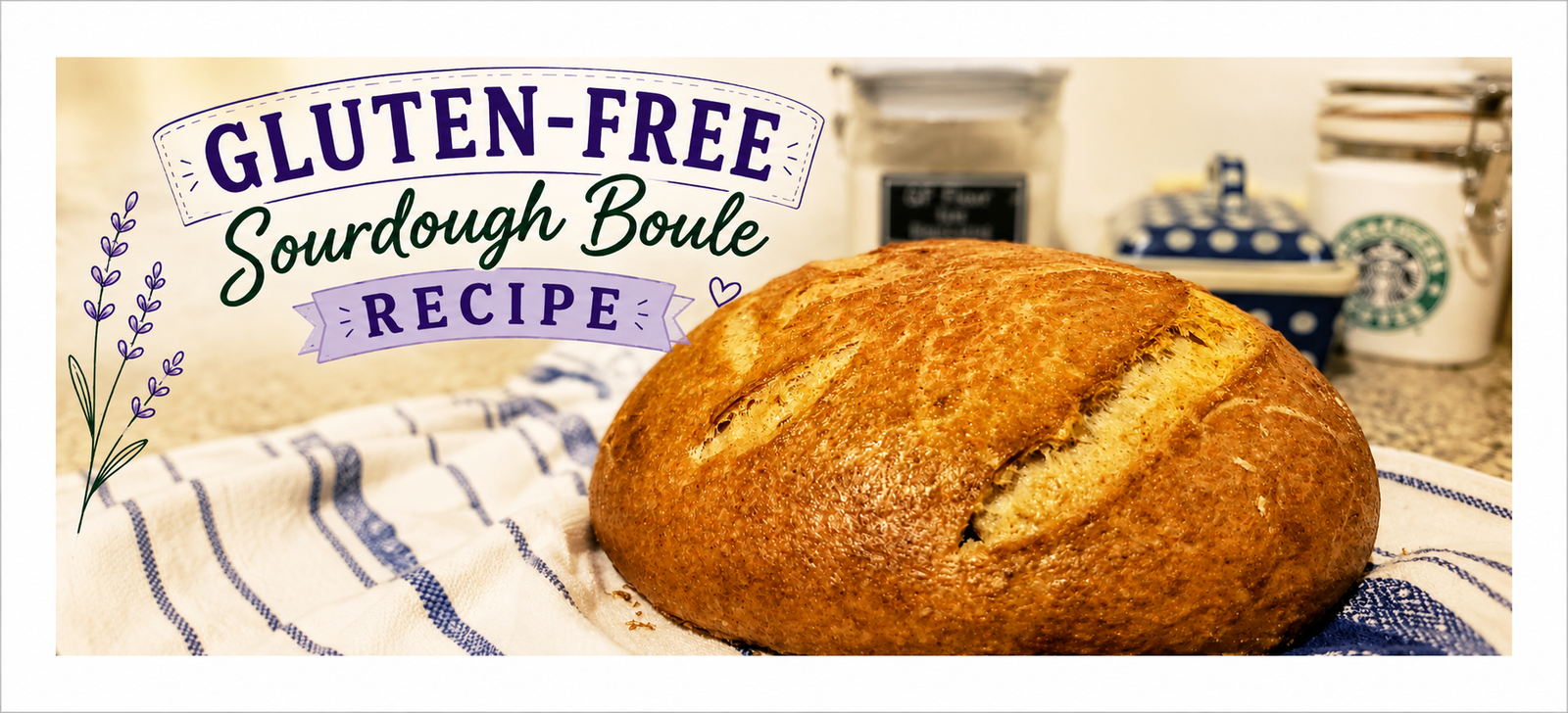
GF Sourdough Boule
While there is no such thing as "fool-proof", this recipe is very close to it. I created it to be very forgiving - one that can grow into your starter's strength. It has been made with several flours successfully: Caputo Fioreglut, King Arthur (bread Flour, 1:1 and all purpose), Namaste, Pamela's to name a few. The most successful has been Caputo - amazing results all the way around. The most mediocre has been from Bob's 1:1 - great flavor but more dense and a bit gummy. Great once sliced and toasted though.
Print
Pin
Equipment
- 1 Cast Iron Dutch Oven (non-enameled) 3qt is ideal, 5 qt works too
- Small Glass Mixing Bowl a smaller bowl keeps the dough ball tight
- Proofing Cloth or Tea Towel for the bowl
- Stand Mixer Can be done by hand, but double the mixing time
- Bread Sling or Parchment Paper If using parchment paper be sure it is rated for high temp
- Bench Scraper Useful but optional
Ingredients
Wet Ingredeients
- 265 g sourdough starter at peak
- 280 g water warmed to 112℉
- 12 g psyllium husk powder blonde, to avoid purple
- 5 g active yeast (optional) use if starter is less than 30 days. Omit for older, stronger starters
- 10 g honey
- 1 Tbsp apple cider vinegar can increase to 2 Tbsp if you want to also enhance the sour flavor
- 20 g olive oil
Dry Ingredients
- 320 g Caputo Fioreglut or KA Bread Flour other GF flour blends may work, see list in description
- 40 g Almond Flour fine ground - I use Bob's Red Mill
- 1 Tbsp Nutritional Yeast Optional, but adds protein and helps with structure
- 2 tsp baking powder be sure it is double acting
- 12 g kosher sea salt do not use iodized
Instructions
Preparing your sourdough starter
- In the morning, feed your starter enough to create the 265g for the recipe, plus additional to account for what is absorbed/evaporated and enough to maintain for future bakes. A total of 350g is a good number to go for.
- Once it has peaked (or just prior) it is ready to mix.
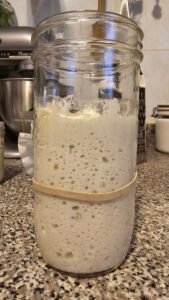
Note that a thicker starter is best for this recipe, so don't follow the usual "pancake batter rule"
Example: 50g starter - 150g gf flour - 150g water
It might take a little bit longer than it normally does to peak, since you are feeding it more than the usual 1:1:1. . If it normally doubles, watch for this Levain to double. If it normally rises by 50%, that is what you will watch for.
Make psyllium gel
- Warm 200g water to 112°f
- Whisk in gel, being careful to break up any lumps
- Set aside 10-15 minutes to gel
- Remove any remaining lumps before adding to other ingredients
Proof the yeast (if using)
- Warm the remaining 130g water to 112°f
- Add honey and yeast, stir
- Set aside for 5 minutes
- If top is foamy the yeast is good and ready to be added to other ingredients.
- If no or very little foam the yeast is likely no good. Omit or repeat this step using a fresh jar or packet.
Wet Ingredients
- To large mixing bowl add all wet ingredients: peaked starter, psyllium gel, proofed yeast (or water/honey), olive oil and apple cider vinegar.
- Use paddle attachment to mix until well blended.
- Change to dough hook
Dry Ingredients
- In a large bowl, sift or whisk together all dry ingredients: Flours, baking powder, nutritional yeast, salt.
- Turn mixer onto low, slowly add dry ingredients to wet.
- Once all is incorporated stop the mixer. Scrape sides of bowl down with spatula
- Increase speed to medium, mix for 5 minutes.
Knead & Shape
- Place dough onto floured surface, it will be sticky!
- Gently knead in more flour, a few grams at a time, until the dough is no longer wet. It should be mildly tacky but manageable, and will hold it's shape for a few seconds.
- Gently shape into a tight small ball
- Fold dough in half, turn, fold in half again.
- Stretch each side into the center, pinching to seal.
- Repeat if needed to create a small tight round ball.
- Lightly flour if needed to prevent too much sticking.
Go to https://www.youtube.com/watch?v=iKxjuQh296k&t=3s to see my video on fix your dough if it seems too wet or sticky, and to see how I shape it for proofing
Proof
- Prepare a bowl for proofing by lining it with a tea towel or proofing cloth.
- Dust the cloth with white rice flour
- Gently lift dough and place it in the bowl, seam side up.
- Oil hands generously with olive oil and pat the exterior of the dough. This helps keep the dough soft as the liquid evaporates, makes a softer crust when baking.
- Cover with another tea towel and place in a warm location (75-80°f is ideal)
- Depending on how warm the location and how active your starter/yeast is it can take anywhere from 2-5 hours to proof, sometimes longer. The top should be starting to dome.
The "finger poke test" has worked well for me: Gently press on the dough, creating about a 1/4 inch indentation. Observe.- If it springs back quickly, it's underproofed- if it slowly springs back leaving a slight indentation it's ready- if it doesn't spring back at all, it's overproofed
Final Shape
- Once dough is proofed, it is time to do a final shape.
- Remove the towel, dust with white rice flour, and place your parchment paper or bread sling on top of the bread (the visible part of the dough will become the botton of your loaf).
- Very gently invert and place on the counter
- Tighten the loaf by gently tucking the sides under towards the center.
- Place in freezer while the oven and Dutch Oven preheats
Watch this video to see how I shape after proofing: https://www.youtube.com/watch?v=zlff0ls5Ivs
Prep to Bake
- Once proofed dough is placed in the freezer, begin pre-heating the oven & Dutch Oven to 500°f
- After 30 minutes, gently remove the dough from the freezer.
- Sprinkle liberally with white rice flour, if desired, and score.
Bake
- Reduce heat of oven to 450°f and remove DO.
- Liberally spritz the top of your dough with water, toss in a couple of ice cubes (only if using non-enameled DO) then quickly lower your dough in and place lid to trap steam.
- Bake 40 minutes covered, then remove from the oven.
- Reduce temp to 425° and gently return bread only directly on the rack.
- Continue baking additional 20 minutes, or until the internal temp of the bread reaches 210°f.
- Place on a cooling rack and allow to cool at least 4 hours before slicing. It will continue to develop as it sits, cutting too soon can interrupt the process and result in gummy interior.
- After 2 hours I wrap mine in a tea towel to absorb excess moisture and soften the crust.
Video
